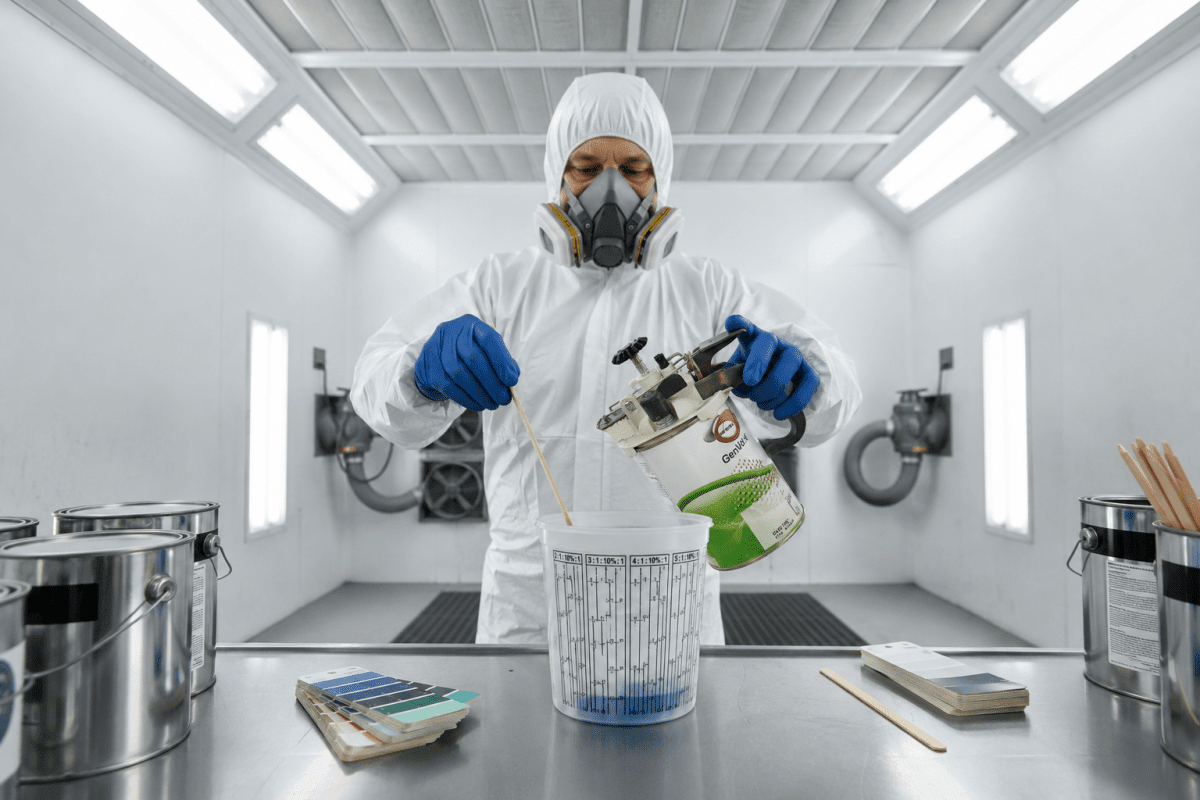
Paint Mixing Ratios Explained: Why Proper Mixing Matters for Professional Results
Whether you're spraying primer, basecoat, or clearcoat, achieving a flawless automotive finish starts long before you pull the trigger on the spray gun. One of the most overlooked—but most critical—steps in the refinishing process is mixing your paint products according to the manufacturer's recommended ratios.
Every automotive coating is engineered to perform within a specific chemical balance. Mixing too much hardener, not enough reducer, or estimating instead of measuring can affect everything from color match and gloss to adhesion, flow, drying time, and long-term durability.
Using the proper mixing ratio every time ensures your products perform exactly as the manufacturer intended. It also creates consistency from one batch to the next, making color blending easier and helping eliminate costly rework.
Why Paint Mixing Ratios Matter
Automotive paint systems are formulated to work as complete systems. Each component—paint, activator (hardener), and reducer—has a specific job.
When mixed correctly, these ingredients work together to provide:
-
Proper viscosity for spraying
-
Excellent atomization through the spray gun
-
Smooth flow and leveling
-
Consistent flash and cure times
-
Correct orientation of metallics and pearls
-
Maximum adhesion between coats
-
Long-term durability and chemical resistance
Even small changes in the mixing ratio can alter how the coating performs.
For example:
-
Too much reducer can make the coating too thin, increasing the chance of runs, sagging, or poor hiding.
-
Too little reducer can create excessive orange peel and poor atomization.
-
Too much hardener may cause the product to cure too quickly, reducing working time and potentially leading to brittleness.
-
Too little hardener can leave coatings soft, slow to cure, or unable to reach their designed hardness.
Mixing Primer Correctly
Primer creates the foundation for the entire paint job. Whether you're using an epoxy primer, urethane primer surfacer, or primer sealer, the correct mixing ratio is essential.
Manufacturers carefully formulate primers to:
-
Build film thickness
-
Fill sanding scratches
-
Promote adhesion
-
Sand properly
-
Seal the surface before color
Mixing primer incorrectly can result in:
-
Poor adhesion
-
Extended drying times
-
Difficult sanding
-
Shrinkage after painting
-
Poor topcoat appearance
Most primers require a combination of primer, activator, and sometimes reducer. Typical mixing ratios are 4:1:1 with hardener and reducer or 1:1 with thinner. Always follow the technical data sheet (TDS) for the exact ratio and induction time if required.
Basecoat Mixing Ratios
Basecoat provides the vehicle's color and appearance, but it's designed to cover the body panels and trim only, not to provide protection.
Many solvent-based basecoats use common mixing ratios such as:
-
1:1
-
2:1
Waterborne systems follow different procedures, making it especially important to reference the manufacturer's recommendations.
Properly mixed basecoat offers:
-
Consistent color
-
Uniform metallic orientation
-
Better blending
-
Smooth application
-
Proper flash times between coats
Incorrect mixing can lead to:
-
Mottling
-
Streaking
-
Poor color match
-
Dry spray
-
Longer flash times
-
Solvent trapping under clearcoat
Consistency is especially important when mixing multiple cups during larger jobs. Every batch should be identical to ensure color consistency across the entire repair.
Clearcoat Mixing Ratios
Clearcoat is responsible for gloss, UV protection, chemical resistance, and durability.
Unlike basecoat, clearcoat depends heavily on precise chemical reactions between the clear and hardener.
Common mixing ratios include:
-
2:1
-
4:1
-
4:1:1
-
2:1:10%
Mixing clearcoat accurately provides:
-
Excellent gloss retention
-
Proper hardness
-
Chemical and UV resistance
-
Scratch resistance
-
Long-lasting durability
Improper ratios may result in:
-
Loss of gloss
-
Dieback
-
Soft finishes
-
Solvent popping
-
Poor cure
-
Reduced durability
Because clearcoat is often the final step in the refinishing process, taking a few extra moments to measure accurately can make the difference between an average finish and a show-quality result.
Consistency from Cup to Cup
Professional painters know that consistency is everything.
When spraying a complete vehicle, multiple panels, or blending adjacent panels, you'll likely mix several batches throughout the job.
Eyeballing measurements or using makeshift containers introduces unnecessary variation.
Accurate measuring ensures:
-
Every batch sprays the same
-
Viscosity remains consistent
-
Spray gun settings stay predictable
-
Metallic colors remain uniform
-
Flash and cure times stay consistent
Repeatable mixing helps eliminate variables, allowing you to focus on technique rather than correcting avoidable mistakes.
Choosing the Right Paint Mixing Cup
One of the easiest ways to improve consistency is by using a dedicated automotive paint mixing cup.
High-quality mixing cups eliminate guesswork by providing clearly marked ratio scales that make measuring fast and accurate.
High Teck Quart Mixing Cups
High Teck Mixing Cups are designed specifically for automotive refinishing professionals and DIY painters alike.
These solvent-resistant polypropylene cups feature easy-to-read graduations that help ensure every batch is mixed accurately.
Features include:
-
Solvent-resistant polypropylene construction
-
Strong, durable design that resists cracking
-
Easy-to-read ounce and milliliter graduations
-
Popular mixing ratios from 1:1:1 through 8:1:1
-
Convenient 10% reduction scales on common mixing ratios
-
Many sizes from Pint, Quart, to 5 quart size
-
Pack of 50 to 100 cups, individual cups for sale as well for jobs
Easy-to-Read Mixing Ratio Scales
One of the biggest advantages of High Teck mixing cups is the variety of printed ratio scales.

Whether your product calls for:
-
1:1
-
2:1
-
3:1
-
4:1
-
5:1
-
6:1
-
8:1
-
or three-component mixes such as 4:1:1
the corresponding scale is already printed on the cup.
Simply fill the first component to the desired number on the scale, add the second component to the next matching mark, and if required, add reducer using the third scale. Many of the most common ratios also include a built-in 10% reduction guide, making it easy to accurately add reducer without additional calculations.
This simple system reduces mixing errors, speeds up workflow, and helps deliver repeatable results throughout the repair process.
Additional Tips for Accurate Paint Mixing
To get the best performance from your coatings:
-
Always read the manufacturer's Technical Data Sheet (TDS) before mixing.
-
Stir products thoroughly before measuring, especially primers, metallic basecoats, and flat finish clearcoats.
-
Use clean mixing cups for every batch to prevent contamination.
-
Mix only the amount you'll use within the product's pot life.
-
Strain mixed paint before pouring it into the spray gun.
-
Follow recommended temperature ranges, as mixing ratios and reducer speeds are often designed around specific shop temperatures.
-
Never substitute activators or reducers unless approved by the paint manufacturer. Using a substitute product can negatively affect paint match and hardness.
Final Thoughts
Great paint jobs don't happen by accident—they're built on precision. Following the manufacturer's recommended mixing ratios for primer, basecoat, and clearcoat ensures each product performs as intended, delivering proper flow, cure, adhesion, gloss, and long-term durability.
Pairing those recommendations with a quality mixing cup, such as the High Teck Quart Mixing Cup, makes it easy to measure accurately every time. With clearly printed ratio scales, solvent-resistant construction, and built-in reduction guides, these cups help eliminate guesswork and provide consistent results from the first mix to the last.
Whether you're a collision repair professional or a weekend restoration enthusiast, accurate mixing is one of the simplest—and most important—steps toward achieving a smooth, durable, professional-quality finish.